

Choosing the right market making technique can feel overwhelming when you're staring at a screen full of order books, bots, and competing strategies. Prediction markets have exploded in popularity, and with that growth comes a flood of no-code automation tools promising easy profits. But not every approach fits every market or trader. This article breaks down the key market making techniques, compares the leading automation models, and gives you a clear framework for picking what works for your goals. Whether you're brand new to prediction markets or already running bots, you'll walk away with a sharper, more actionable plan.
Table of Contents
- Key criteria for evaluating market making techniques
- Core market making techniques and how they work
- Popular automation models: Stoikov, LMSR, and CLOB explained
- Performance insights: What the data says about maker returns and risk
- Situational recommendations: Matching techniques to your market and goals
- Expert perspective: The missed truths and hidden edges in prediction market making
- Next steps: Automate your market making with PredictEngine
- Frequently asked questions
Key Takeaways
| Point | Details |
|---|---|
| Automation is accessible | No-code bots allow anyone to deploy advanced market making and arbitrage strategies in prediction markets. |
| Techniques fit different markets | Choose Stoikov, LMSR, or CLOB models based on market volume, volatility, and your risk comfort. |
| Data-driven selection wins | Real-world returns and risk vary by market sector, so use empirical evidence to pick the best approach. |
| Edge persists in biased markets | Maker profits are highest where retail bias or inefficiencies are common. |
Key criteria for evaluating market making techniques
Before picking a technique, you need to know what separates a good fit from a bad one. Not all market making strategies perform the same way across different prediction markets. Here's what actually matters when you're evaluating your options.
Core market making techniques include bid-ask spread capture, inventory management via quote skewing, and cross-market arbitrage. Each of these levers affects your profitability and risk differently depending on the market you're in.
Key evaluation criteria:
- Profit drivers: Spread capture rewards you for providing liquidity. Arbitrage lets you profit from price gaps across platforms. Capturing mispricings rewards deeper research and faster execution.
- Risk controls: Inventory risk builds up when your positions become unbalanced. News events or sudden resolution can cause sharp price jumps that hurt unhedged positions.
- Automation level: Fully automated bots handle quoting 24/7 without your input. Semi-automated approaches let you set rules but still require manual oversight.
- No-code accessibility: If you're not a developer, the tool's interface matters as much as the strategy itself. Drag-and-drop builders and natural language setup lower the barrier significantly.
- Liquidity needs: Thin markets (low trading volume) require different strategies than high-volume books. Spreads tend to be wider in thin markets, which can mean more profit per trade but also more inventory risk.
Pro Tip: Focus on markets where participant bias is persistent and measurable. When retail traders consistently overestimate certain outcomes, like popular sports teams or trending political candidates, you can systematically profit from that gap.
Core market making techniques and how they work
Now that you know what to look for, let's examine how each core market making method operates in practice.
Here are the four primary techniques used by successful prediction market makers:
- Bid-ask spread capture: You post simultaneous buy (bid) and sell (ask) offers on the same market. When other traders hit both sides, you pocket the difference. This is the foundation of most market making strategies and works best in active markets with steady flow.
- Inventory management via quote skewing: When your position tilts too far in one direction, you adjust your quotes to attract trades that rebalance you. For example, if you're holding too many YES shares, you lower your YES ask to sell them faster. This limits inventory risk from sudden price moves.
- Cross-market arbitrage: If the same event trades at different prices on two platforms, you buy on the cheaper side and sell on the more expensive one. The gain is nearly riskless if executed fast enough. This is especially powerful in prediction markets where price discovery lags across platforms.
- Event-driven spread adjustment: As a market nears resolution, uncertainty drops but volatility spikes. Smart makers widen spreads near resolution to protect against sharp moves. This is a critical adjustment that many beginners overlook.
One of the most underappreciated edges in prediction markets is what researchers call the "optimism tax." As noted in market microstructure research, makers capture the optimism tax from biased YES takers, and market efficiency is higher in finance than in sports or entertainment due to participant sophistication.
"Core market making techniques include bid-ask spread capture, inventory management via quote skewing, and cross-market arbitrage."
For a deeper look at deploying these methods, check out the guide on advanced market making on Polymarket and top Polymarket trading strategies.
Popular automation models: Stoikov, LMSR, and CLOB explained
Understanding techniques is step one. Next, let's look at the automation models that make no-code tools possible.
Three models power most prediction market bots today. Each has a distinct logic, and knowing which fits your situation saves you from costly mismatches.
Model comparison table:
| Model | Key feature | Best for | Major platforms |
|---|---|---|---|
| Stoikov | Adaptive quoting with risk adjustment | Binary, volatile event markets | Custom bots, Polymarket |
| LMSR | Always-on liquidity guarantee | Thin or low-volume markets | Augur, smaller platforms |
| CLOB | Order book matching, high-frequency capable | Active, high-volume markets | Polymarket, Kalshi |
Stoikov adaptations for prediction markets use jump-diffusion for news shocks and logit transforms for binary probabilities, and they outperform GARCH and random walk models in backtests. This makes Stoikov-based bots especially well-suited for fast-moving political or economic events.

LMSR versus CLOB: LMSR guarantees liquidity but needs a dynamic parameter (called LS-LMSR) to stay efficient; CLOB enables high-frequency market making but risks thin order books in low-participation markets.
Pros and cons at a glance:
- Stoikov: Handles volatility well and adapts to binary outcomes. Requires more configuration upfront.
- LMSR: Simple and always liquid. Can be less profitable in high-volume markets where spreads compress.
- CLOB: Maximum flexibility and speed. Can leave you exposed in low-volume situations.
For traders ready to automate, exploring fully automated trading bots and crypto arbitrage opportunities can help you match the right model to your market.
Performance insights: What the data says about maker returns and risk
Once automation models are clear, let's see what actual results and risk factors look like in live prediction markets.
The numbers here are eye-opening. Empirical data from Kalshi, covering 72 million trades and $18 billion in volume, shows that makers earn an average excess return of +1.12% while takers lose 1.12% on average. The gap is widest in entertainment markets at 4.79 percentage points and narrowest in finance at just 0.17 percentage points.
Returns and risk by sector:
| Sector | Maker excess return | Taker excess return | Maker edge |
|---|---|---|---|
| Entertainment | High | Negative | 4.79pp gap |
| Sports | Moderate | Negative | Mid-range |
| Finance | Low | Near zero | 0.17pp gap |
These numbers confirm what experienced traders already suspect: entertainment and sports markets are where participant bias runs hottest, and that bias is your profit source.
But risk is real too. Inventory risk from event-driven jumps is a major threat, and spreads tend to widen near resolution. Perhaps most importantly, market manipulation persists for up to 60 days in low-volume markets but fades in high-volume ones.
Pro Tip: Target markets with less competition and measurable participant bias. Entertainment and niche political markets often offer the best excess returns for makers who manage inventory carefully.
For more context on turning these numbers into actual income, the guide on real-world profit methods and sports market strategy tips are worth your time.
Situational recommendations: Matching techniques to your market and goals
With data and models in hand, here's how to match your approach to your market and trading strengths.
The right technique depends on three things: your risk tolerance, the market you're targeting, and how much time you want to spend managing positions. Here's a practical breakdown.
Ideal approach by trader type:
- Beginner with no coding skills: Use LMSR-based bots in thin or niche markets. Low setup friction, consistent liquidity, and manageable risk make this the safest entry point.
- Active trader in sports or entertainment: Lean on bid-ask spread capture and exploit participant bias. These markets have the widest maker edges due to retail overconfidence.
- Quantitative or data-driven trader: Stoikov bots with jump-diffusion settings are your best tool for binary or volatile event markets.
- High-frequency or volume trader: CLOB on Polymarket or Kalshi gives you the speed and depth you need, but monitor thin-book risk closely.
- Arbitrage-focused trader: Cross-market arbitrage scanning tools let you catch price gaps across platforms with near-zero directional risk.
Market efficiency is higher in finance due to participant sophistication, which means finance markets offer less room for bias-based edges. Sports and entertainment are where the real opportunities sit for most traders.
Exploring best platforms for market making and contrarian strategy tips can help you refine your situational fit even further.
Expert perspective: The missed truths and hidden edges in prediction market making
Most guides tell you to pick a model, deploy a bot, and let it run. That framing misses something important.
Automation does not eliminate the need for strategy. Bots amplify whatever logic you feed them. A poorly calibrated bot in a manipulated or thin market will lose money faster than a manual trader who's paying attention. The tool is only as good as the judgment behind it.
Here's what most articles won't tell you: the biggest edge in prediction markets isn't the most sophisticated algorithm. It's deploying simple, repeatable logic in markets that are under-analyzed and participant-biased. The real-life trading case studies consistently show that straightforward spread capture in entertainment or niche political markets outperforms complex models in heavily traded finance markets.
Another overlooked truth: most makers overestimate how safe spreads are. Manipulation, thin order books, and sudden event resolution can wipe out weeks of spread income in a single trade. Risk management isn't optional. It's the actual job.
The hidden edge is systematic. Harvest the optimism tax where retail traders dominate. Stay disciplined about inventory. And never assume your bot is smarter than the market it's operating in.
Next steps: Automate your market making with PredictEngine
If you're ready to move from strategies to action, here's how to start automating your market making.
PredictEngine makes it straightforward to deploy market making and arbitrage bots without writing a single line of code. The platform's drag-and-drop builder and natural language setup let you configure your strategy in minutes.
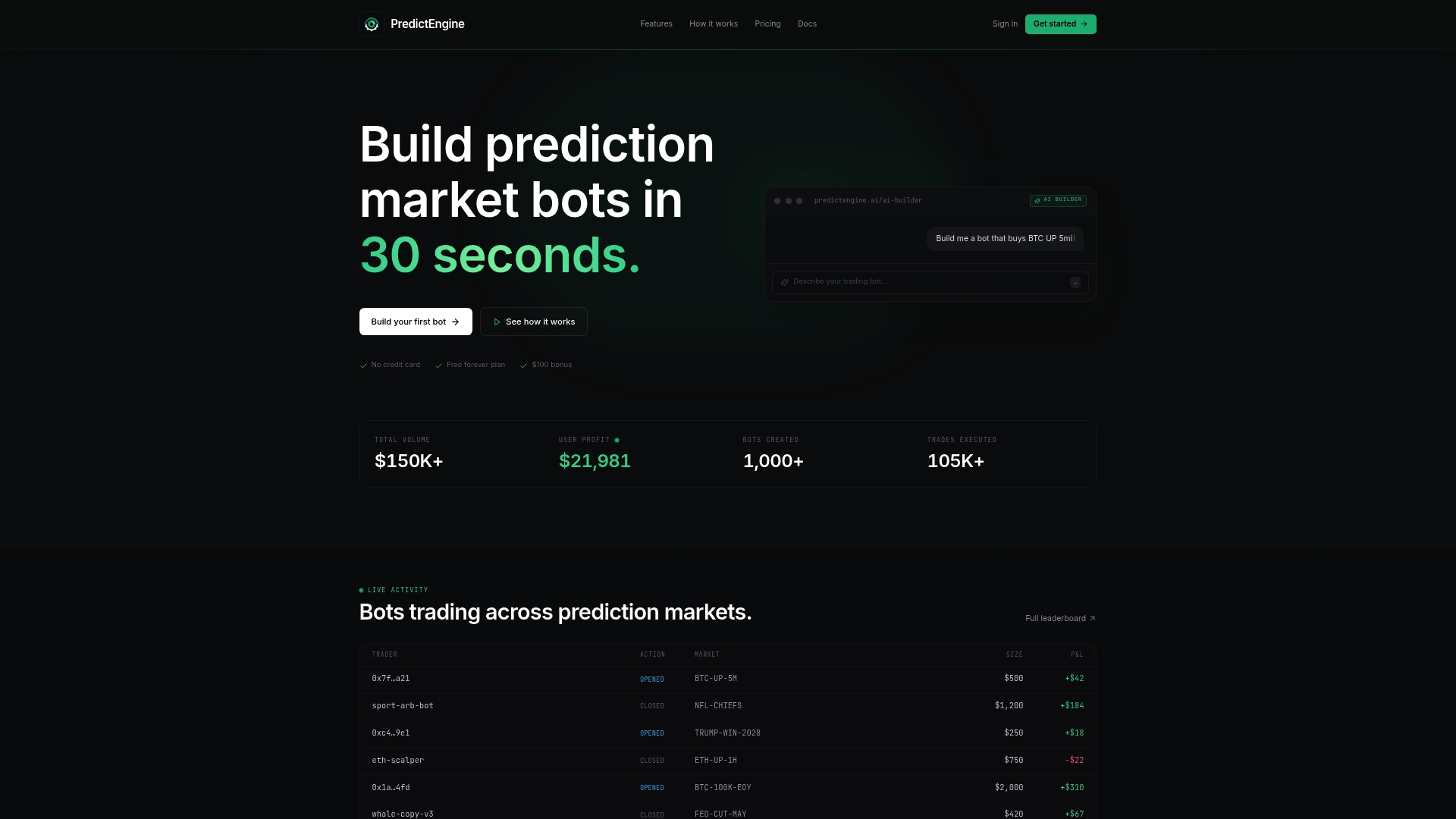
Whether you want to run a Stoikov-style bot on volatile markets or scan for cross-market price gaps, the automated trading bot and Polymarket arbitrage tool give you the tools to act on everything covered in this article. Visit the PredictEngine platform to explore subscription plans, set up your first bot, and start capturing market making returns today.
Frequently asked questions
What is the safest market making technique for beginners?
LMSR bots in low-volume markets are considered safest because they guarantee consistent liquidity and carry minimal inventory risk compared to CLOB-based approaches.
Which automation model has the best performance in volatile prediction markets?
The adapted Stoikov model with jump-diffusion settings outperforms alternatives like GARCH and random walk models for handling news shocks and binary outcomes in backtests.
What returns do market makers typically achieve?
On Kalshi, across 72 million trades and $18 billion in volume, makers earned an average excess return of +1.12%, with the largest edge in entertainment markets at a 4.79 percentage point gap.
How can I manage inventory risk as a market maker?
Continuously skew your quotes toward your overweight side and widen spreads during volatile event periods to limit exposure and protect against sudden resolution moves.
Is market making profitable for non-coders using automated tools?
Yes. With no-code bots that handle spread capture and arbitrage automatically, traders can capture consistent returns, especially in less competitive or participant-biased markets.