

Only about half of all crypto copy traders actually finish in profit. A large-scale study tracking over 100,000 participants found that just 48.48% of copy traders ended up profitable over a 90-day period. That number should stop you in your tracks, because it means the strategy alone is not enough. The difference between the traders who win and those who lose comes down to preparation, leader selection, and smart execution. This guide walks you through every step, from understanding how copy trading actually works to monitoring your results and improving over time.
Table of Contents
- Understand what makes copy trading work (and fail))
- Set up for success: Requirements, tools, and filtering criteria
- Step-by-step: How to implement your copy trading strategy
- How to evaluate, troubleshoot, and continuously improve
- Why most copy traders fail (and how you can be different))
- Automate your trading and discover leading tools
- Frequently asked questions
Key Takeaways
| Point | Details |
|---|---|
| Profitability isn’t guaranteed | Less than half of copy traders turn a profit, highlighting the need for careful leader selection. |
| Setup and filters matter | Success hinges on using strong filtering criteria, trusted platforms, and automation tools. |
| Continuous evaluation | Ongoing monitoring and strategy adjustments are required to maintain successful copy trading. |
| Fact over hype | Data-driven decisions outpace marketing claims and emotional following in copy trading. |
Understand what makes copy trading work (and fail)
Copy trading sounds simple: you follow a skilled trader, and their trades automatically replicate in your account. But the mechanics underneath are more complicated than that. Fewer than half of copy traders make money, even though most leaders themselves are profitable. The gap between leader performance and follower outcomes is real, and it has specific causes.
The three biggest culprits are slippage, fee drag, and risk profile mismatch.
- Slippage is the difference between the price a leader gets and the price your copied trade executes at. In fast-moving markets, this gap can eat into profits significantly.
- Fee drag refers to the cumulative cost of trading fees on every copied order. Even small fees compound quickly across dozens of trades.
- Risk profile mismatch happens when a leader trades with high leverage or large position sizes that do not match your own capital or risk tolerance.
Platform choice also matters more than most traders realize. Win rates and profitability differ widely between platforms like Bybit and Binance, largely because of differences in execution speed, fee structures, and the quality of available leaders.
| Factor | Impact on follower outcomes |
|---|---|
| Slippage | Reduces entry/exit quality |
| Trading fees | Compounds across all trades |
| Leader risk style | May not match your tolerance |
| Platform execution speed | Affects trade replication timing |
| Leader transparency | Determines trust and accuracy |
"Most traders assume that copying a profitable leader guarantees profit. The data says otherwise. Execution quality, fees, and leader selection are what actually determine your outcome."
Before you follow anyone, understand the requirements for success: full transparency from the leader, a reliable platform with fast execution, and accurate trade replication. Learning about choosing leaders for copy trading on prediction markets like Polymarket is a strong starting point.
Set up for success: Requirements, tools, and filtering criteria
With the basics established, you need to build the right environment before placing a single copied trade. Getting this setup right is what separates traders who profit from those who struggle.
What you need to get started:
- A verified account on a platform that supports copy trading
- Sufficient trading capital (start with an amount you can afford to lose entirely)
- Access to leader statistics including win rate, drawdown history, and public PnL
- A filtering method to screen out leaders with inflated or unreliable stats
- Optional but recommended: an automation tool or bot to handle replication
Success depends heavily on filters, fees, slippage, and carefully selecting leaders. That means you cannot skip the vetting process.

| Platform | Strengths | Weaknesses |
|---|---|---|
| Polymarket | Transparent on-chain data | Fewer copy tools natively |
| Bybit | Built-in copy trading tools | Higher fee tiers for followers |
| Binance | Large leader pool | Harder to verify leader quality |
When evaluating leaders, focus on these stats:
- Win rate over 60+ days: Short-term streaks are not reliable indicators.
- Maximum drawdown: How much did they lose at their worst point? Lower is better.
- Risk-adjusted returns: High profits with extreme risk are not sustainable.
- Consistency: Look for steady growth, not spikes followed by crashes.
For prediction markets specifically, reviewing top sports bettors on Polymarket gives you a real-world benchmark for what strong leader performance looks like. You can also explore Polymarket bot strategies to understand how automation fits into your setup.
Pro Tip: Filter out any leader whose maximum drawdown exceeds 30% of their peak balance. Leaders who protect capital during losing streaks are far more likely to deliver consistent follower outcomes.
Step-by-step: How to implement your copy trading strategy
Armed with your toolkit and filtering criteria, you are ready to deploy your strategy. Follow these steps in order and do not skip ahead.
- Link your account to the copy trading platform. Complete identity verification and fund your account with an amount you have budgeted specifically for copy trading.
- Search and filter leaders. Use the criteria from the previous section. Shortlist two or three candidates before committing.
- Review each leader's full trading history. Look at performance across different market conditions, not just recent results.
- Set your allocation. Decide what percentage of your capital to assign to each leader. Never put everything behind one leader.
- Configure your bot or replication settings. Set position size limits, stop-follow thresholds, and any fee caps your platform allows.
- Run a test period with a small allocation. Start with 10% to 20% of your planned capital to verify execution quality before scaling up.
- Monitor daily for the first two weeks. Check that trades are replicating correctly and that your P&L is tracking close to the leader's reported results.
Win rates, fees, and outcomes differ greatly depending on platform and execution, which is why testing before scaling is non-negotiable.
| Step | Key action | What to verify |
|---|---|---|
| Account setup | Fund and verify | Correct platform access |
| Leader selection | Apply filters | Stats are transparent and current |
| Allocation | Set position limits | Capital is spread across leaders |
| Bot configuration | Set thresholds | Replication triggers correctly |
| Test period | Small allocation | P&L matches leader closely |
Pro Tip: If your copied trades are consistently executing at worse prices than the leader's reported entries, your platform may have a replication delay. Switch platforms or reduce position frequency to minimize this effect.
For broader context on how to structure your approach, Polymarket trading strategies covers useful frameworks. You can also compare options by looking at best Polymarket trading bots to find tools that fit your workflow.
How to evaluate, troubleshoot, and continuously improve
Once trades are underway, the work is not over. Monitoring and iteration are what turn a decent copy trading setup into a consistently profitable one.
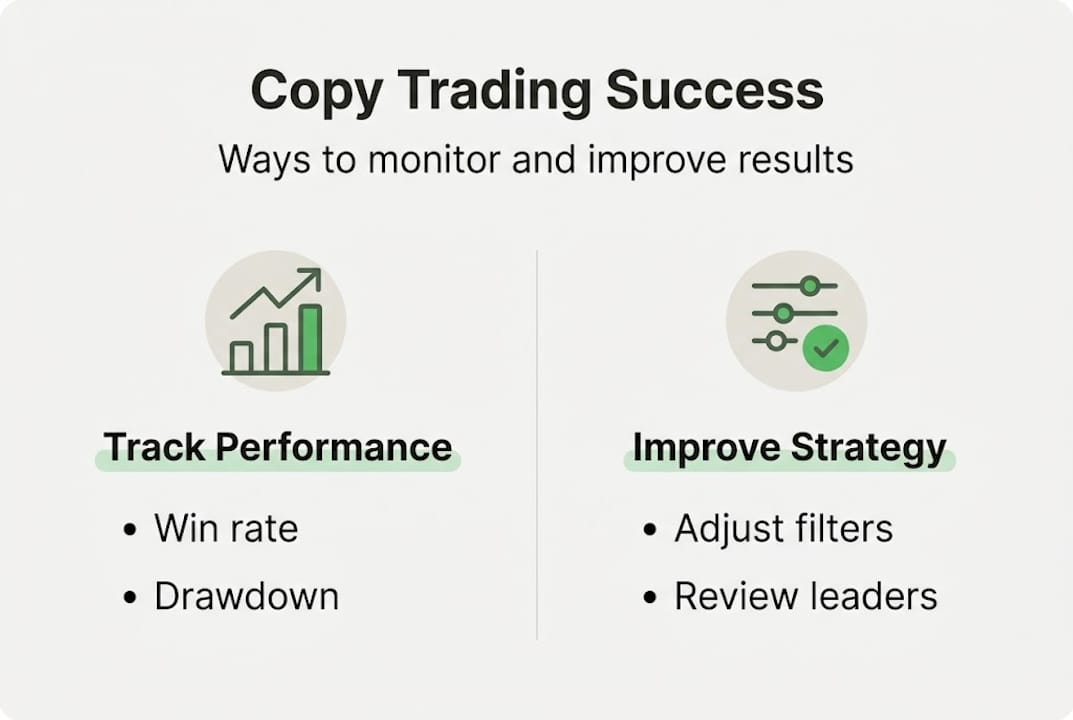
How to track your actual P&L vs. leader results:
Keep a simple spreadsheet or use your platform's analytics dashboard. Record the leader's reported return for each period alongside your actual follower return. Any consistent gap wider than 2% to 3% is a red flag worth investigating.
Numbered troubleshooting process:
- Check for trade deviations. Compare your executed trades against the leader's reported trades line by line.
- Identify the root cause. Common causes include replication delays, failed trade executions, fee differences, or the leader changing their strategy without notice.
- Assess whether the leader is still aligned with your goals. Leaders evolve. A strategy that worked three months ago may carry very different risk today.
- Adjust or replace. If the root cause cannot be fixed at the platform level, consider reducing allocation to that leader or switching entirely.
Common pitfalls to watch for:
- High platform fees that silently reduce your net returns
- Slippage that compounds across high-frequency trades
- Leaders with inflated stats from low-liquidity markets
- Bots left unmonitored during periods of high market volatility
Follower-level outcomes vary due to fees, slippage, and poor leader selection, which is why ongoing review is just as important as your initial setup.
"Set a calendar reminder every two weeks to review your copy trading performance. Markets change, leaders change, and your strategy needs to keep up."
For additional frameworks on protecting your capital, risk-free betting strategies and proven winning strategies offer practical guidance you can apply directly to your monitoring process.
Why most copy traders fail (and how you can be different)
Here is the uncomfortable truth about copy trading: most people approach it as a passive income shortcut. They see a leader with impressive recent profits, allocate a chunk of capital, and expect the returns to follow automatically. The data does not support that approach.
Follower-level evidence shows coin-flip profitability despite industry hype. That means the average copy trader is essentially breaking even at best, and losing money at worst, even when following leaders who are themselves profitable.
The problem is not copy trading as a concept. The problem is that most traders copy the outcome (high PnL) without understanding the method behind it. A leader who made 200% returns in a bull market may be taking on leverage that will wipe followers out in a correction. You need to understand how a leader generates returns, not just that they do.
What strong traders do differently: they treat leader selection like due diligence on an investment. They look at methodology, not just results. They factor in how a leader performs during drawdown periods. They use tools and bots to automate execution while staying actively involved in oversight.
Two actionable steps you can take today: First, never allocate more than 25% of your copy trading capital to a single leader. Second, review advanced trading strategies to build your own judgment about what good trading looks like, so you can evaluate leaders with real context.
Automate your trading and discover leading tools
Now that you understand effective copy trading, the next step is putting the right tools to work for you. Manual monitoring and replication are time-consuming and prone to human error.

PredictEngine is built specifically for prediction market traders who want to automate their strategies without writing a single line of code. You can deploy an AI trading bot for Polymarket that handles leader replication, position sizing, and real-time monitoring automatically. If you want to go beyond copy trading, the platform also identifies risk-free Polymarket arbitrage opportunities across markets. Getting started is fast, and the no-code builder means you can have a working bot live within minutes of signing up.
Frequently asked questions
How much money do I need to start copy trading effectively?
Most platforms let you start with minimal capital, but optimal results come from using an amount you can afford to lose and adjusting allocations carefully to manage risk across multiple leaders.
Is copy trading profitable for the average trader?
Data from over 100,000 copy traders shows only about 48% finished profitably, so careful leader selection and disciplined risk control are essential to beating the average.
What is the biggest risk with copy trading?
The main risks are selecting leaders with unsustainable strategies and the compounding impact of fees, slippage, and delayed trade replication on your actual returns.
How can I choose the best leader to follow?
Evaluate leaders using transparency, historical win rates over at least 60 days, PnL consistency across different market conditions, and drawdown control rather than just recent profits.